Share your homes between naturists,
with complete peace of mind.
Naturists, discover a new way to travel!
Let's share our values
« Naturism is far more than simple nudity: it is a philosophy of life founded on respect for oneself, for others and for nature. »
Our values, your everyday life
Respect
Respect for oneself (accepting who you are), for others (welcoming without judging), for the environment (living lightly on the planet).
Authenticity
Nudity erases status and masks. Everyone is equal, genuine. It makes reaching what truly matters easier!
Freedom
Moving freely, (re)connecting with your body, enjoying the sun, the air, the water. Feeling the natural elements!

Ecology
Sorting waste, local produce, mindful consumption: living in harmony with our planet.
Conviviality
A warm welcome, mutual help, sincere exchanges.
Welcome to a world where authenticity, freedom and respect come alive every day, for rich and rewarding experiences.
By choosing a naturist home-exchange stay, you embrace these values and join a community that puts people, nature and wellbeing at the heart of its priorities.
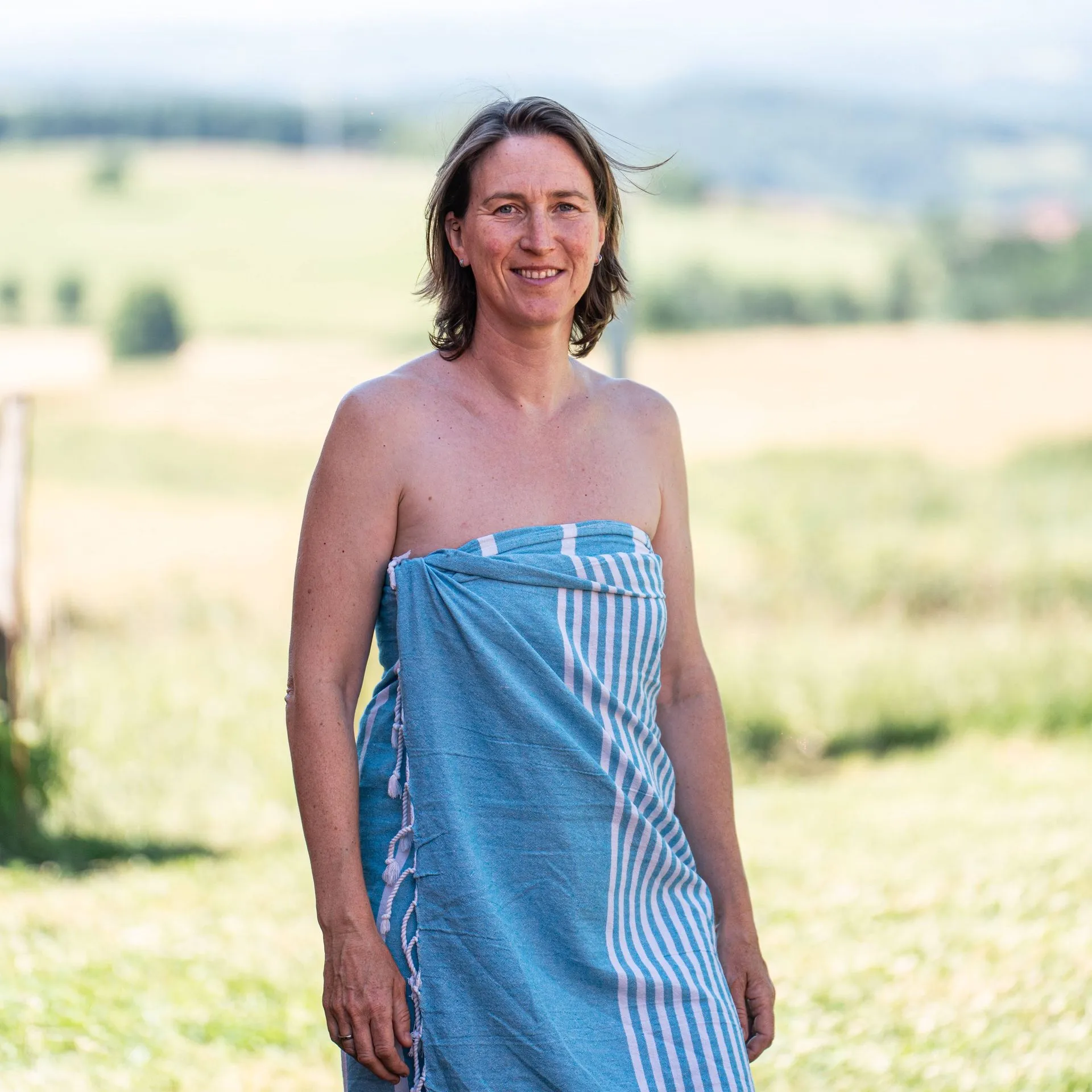
The Be Nat Home story
I would love to do home sitting during my holidays BUT it does not exist for us naturists! I wanted to fill that gap while creating the human connections the world needs so badly. That is how the Be Nat Home site was born!
I have been a naturist for as long as I can remember. I adapted my property so I could live naturism every day. I also go to naturist campsites with my family in high summer.
I love practising naturism with others. I also need to practise it in my everyday life. I host home sitters at my place during my holidays and, outside campsites, I find it hard to find places that work calmly for a family.
I want this site to make possible:
- a practice of naturism that reaches further in time and space,
- cultural exchanges,
- low-cost travel, simply.
Ready to join the community?
Respect, authenticity, freedom, ecology, conviviality.Welcome home.
Join the communityOur partners and resources
We work hand in hand with the long-standing players of naturism in France.
Fédération Française de Naturisme
« Naturism is a way of living in harmony with nature, marked by communal nudity that fosters respect for oneself, respect for others and respect for the environment. »
Naturisme TV
« A web TV dedicated to naturism: more than 500 videos, reports, documentaries and testimonials to live or better understand the practice, with an interactive map of naturist campsites and villages in France. »
The difference between nudity and naturism
It is worth telling apart simple nudity from the broader concept of naturism. Nudity refers to not wearing clothes, whatever the context.
« Naturism is a philosophy of life that embraces freedom of conscience, of expression and of opinion. »
This philosophy is protected by the Declaration of the Rights of Man and of the Citizen and by the European Convention on Human Rights.
Key markers for naturists in France
Three simple markers for practising naturism at home with peace of mind:

Opaque fence 1.80 to 2 m
Not visible from the road or public space: legally, this is the safest setup.

Neighbour's upstairs window ≥ 1.90 m *
To be on the safe side, stay covered in the areas exposed to that view, to limit any risk of conflict with the neighbours.

Neighbour's window < 1.90 m
A building that breaks the "direct view" rule (art. 678 of the French Civil Code). This is an ordinary neighbour dispute, with no direct link to nudity itself.
These first two points define the concept of "usability" used between Be Nat Home members. What makes a home "usable" is therefore different in countries other than France.
* This distance (art. 678 of the Civil Code) creates no obligation to get dressed. The criminal risk under art. 222-32 depends on whether the act is considered sexual or provocative: simple nudity, with no sexual connotation, is in principle not the offence of sexual exhibition (art. 222-32 of the Criminal Code), even if it can be seen from a neighbour's window. Case law on this question is not settled, however.
This information is general in nature and does not constitute legal advice.
Practising nudity and the law in France*
* for all other countries, refer to the law in force in that country.
1. What does the law say about simple nudity at home?
As a reminder, this offence requires several elements together: an act of a sexual or obscene nature, a place where there is a risk of being seen (public, or private but visible from outside), and the intention to impose that sight on others.
On that last point, case law is not settled: courts are generally reluctant to convict when nudity is simple and not provocative, but the authorities themselves acknowledge a gradual shift towards a stricter reading depending on the circumstances. There is therefore no absolute guarantee.
- In short: for simple nudity, with no sexual connotation and no intention to be noticed, judges today rarely find the criminal offence of sexual exhibition. That reading is, however, moving towards a stricter approach.
- On the other hand, a neighbour who is bothered can bring a civil action for abnormal neighbourhood nuisance, regardless of any criminal charge.
This information is general in nature and does not constitute legal advice.
2. Does a fence with small gaps (1 cm for example) limit practising naturism at home?
A 1 cm gap between boards is negligible: at 2 m away (road or neighbour, typically), it is generally hard to notice with the naked eye. It is the manufacturing standard for most wooden or rigid fences.
What can compromise usability:
 Missing fence or a fence that is not high enough (visible from public space or by third parties) Transparent mesh (visible netting) Torn screening fabric
 Fence with a slight 1 cm gap: a common situation, with no practical effect on visibility.
The less the whole area can be seen from outside, whether from the road, a path or a neighbouring property, the lower the risk.
This information is general in nature and does not constitute legal advice.
3. And if there is an overlooking upstairs window more than 1.90 m from your fence?
Under criminal law, the reasoning is the same as in question 1: the risk under art. 222-32 depends on whether the act is sexual or provocative, a question on which case law is not settled. Simple, non-provocative nudity seen from that window is generally not held against you by judges, though this is no absolute guarantee.
Under civil law, however, things are different: a neighbour bothered by the view can bring an action for abnormal neighbourhood nuisance, regardless of any criminal charge. The law does not leave the neighbour without protection: it simply offers a different route (civil rather than criminal).
* Note: the 1.90 m distance in art. 678 of the Civil Code is measured horizontally, from the wall to the property boundary, whatever the floor. A high window can therefore create a lawful view over a ground-level fence, even a fully opaque one. This "overlooking view" is the situation covered here, as opposed to an inadequate or damaged fence, covered in question 2.
This information is general in nature and does not constitute legal advice.
4. And if a neighbour or passer-by looks through the small gaps in the fence?
This differs from a neighbour's window with a direct, lawful view (see question 3): there, the neighbour uses no particular means to see you, they simply have an existing view. Voyeurism requires an active effort to see what has been deliberately hidden from view.
This protection works both ways: if the neighbour's behaviour becomes repeated and genuinely harms your living conditions (recurring hostile remarks, insistent watching, repeated intrusions), you can also bring a civil action for abnormal neighbourhood nuisance, or even file a complaint for harassment (art. 222-33-2-2 of the Criminal Code) if the facts are sufficiently established and repeated.
This information is general in nature and does not constitute legal advice.
5. How is a naturist staying free of charge protected at their host's home?
Since 2024, this principle has been written into the Civil Code (art. 1253): the law explicitly recognises that people simply authorised to occupy a home, not only owners or tenants, are covered by the neighbourhood nuisance rules. A guest staying free of charge with their host's agreement falls into this category.
This information is general in nature and does not constitute legal advice.
Your practical markers
-
 Enclosed, opaque garden: the essential legal condition (no view from outside) is met. This is the safest setup.
 - View from a neighbour's window (≥ 1.90 m)
To be on the safe side, stay covered in the exposed areas. - In case of disagreement with a neighbour: talk first, explain, and show naturism for what it really is!
If needed, the civil route (abnormal neighbourhood nuisance, art. 1253 of the Civil Code) remains open to both parties, regardless of any criminal charge.
This information is general in nature and does not constitute legal advice.
Legal references
General information, not legal advice.
Article 678 of the French Civil Code
Concerns views onto the neighbour's land and the distances to respect.
Amended by Law no. 67-1253 of 30 December 1967, art. 35Created by the Law of 31 January 1804, promulgated on 10 February 1804
Official text, in French:
On ne peut avoir des vues droites ou fenêtres d'aspect, ni balcons ou autres semblables saillies sur l'héritage clos ou non clos de son voisin, s'il n'y a dix-neuf décimètres de distance (1,90m) entre le mur où on les pratique et ledit héritage, à moins que le fonds ou la partie du fonds sur lequel s'exerce la vue ne soit déjà grevé, au profit du fonds qui en bénéficie, d'une servitude de passage faisant obstacle à l'édification de constructions.
Article 226-3-1 of the French Criminal Code
Voyeurism (created by the Law of 3 August 2018).
Summary of paragraph 1: Using any means to see the intimate parts of a person who has hidden them from the view of others (clothing, fence, enclosed place), without their knowledge or consent, is punishable by one year in prison and a €15,000 fine.
Article 222-32 of the French Criminal Code
The offence of sexual exhibition.
In force since 23 April 2021Amended by Law no. 2021-478 of 21 April 2021, art. 12
Official text, in French:
L'exhibition sexuelle imposée à la vue d'autrui dans un lieu accessible aux regards du public est punie d'un an d'emprisonnement et de 15 000 euros d'amende.
Même en l'absence d'exposition d'une partie dénudée du corps, l'exhibition sexuelle est constituée si est imposée à la vue d'autrui, dans un lieu accessible aux regards du public, la commission explicite d'un acte sexuel, réel ou simulé.
Lorsque les faits sont commis au préjudice d'un mineur de quinze ans, les peines sont portées à deux ans d'emprisonnement et à 30 000 euros d'amende.
Article 226-1 of the French Criminal Code
Invasion of privacy (often likened to voyeurism).
In force since 23 March 2024Amended by Law no. 2024-247 of 21 March 2024, art. 4
Official text, in French:
Est puni d'un an d'emprisonnement et de 45 000 euros d'amende le fait, au moyen d'un procédé quelconque, volontairement de porter atteinte à l'intimité de la vie privée d'autrui :
1° En captant, enregistrant ou transmettant, sans le consentement de leur auteur, des paroles prononcées à titre privé ou confidentiel ;
2° En fixant, enregistrant ou transmettant, sans le consentement de celle-ci, l'image d'une personne se trouvant dans un lieu privé.
3° En captant, enregistrant ou transmettant, par quelque moyen que ce soit, la localisation en temps réel ou en différé d'une personne sans le consentement de celle-ci.
Lorsque les actes mentionnés aux 1° et 2° du présent article ont été accomplis au vu et au su des intéressés sans qu'ils s'y soient opposés, alors qu'ils étaient en mesure de le faire, le consentement de ceux-ci est présumé.
Lorsque les actes mentionnés au présent article ont été accomplis sur la personne d'un mineur, le consentement doit émaner des titulaires de l'autorité parentale, dans le respect de l'article 372-1 du code civil.
Lorsque les faits sont commis par le conjoint ou le concubin de la victime ou le partenaire lié à la victime par un pacte civil de solidarité, les peines sont portées à deux ans d'emprisonnement et à 60 000 euros d'amende.
Lorsque les faits sont commis au préjudice d'une personne dépositaire de l'autorité publique, chargée d'une mission de service public, titulaire d'un mandat électif public ou candidate à un tel mandat ou d'un membre de sa famille, les peines sont également portées à deux ans d'emprisonnement et à 60 000 euros d'amende.
Article 1253 of the French Civil Code
Concerns liability for abnormal neighbourhood nuisance.
In force since 17 April 2024Amended by Law no. 2024-346 of 15 April 2024, sole article (V)
Official text, in French:
Le propriétaire, le locataire, l'occupant sans titre, le bénéficiaire d'un titre ayant pour objet principal de l'autoriser à occuper ou à exploiter un fonds, le maître d'ouvrage ou celui qui en exerce les pouvoirs qui est à l'origine d'un trouble excédant les inconvénients normaux de voisinage est responsable de plein droit du dommage qui en résulte.
Sous réserve de l'article L. 311-1-1 du code rural et de la pêche maritime, cette responsabilité n'est pas engagée lorsque le trouble anormal provient d'activités, quelle qu'en soit la nature, existant antérieurement à l'acte transférant la propriété ou octroyant la jouissance du bien ou, à défaut d'acte, à la date d'entrée en possession du bien par la personne lésée. Ces activités doivent être conformes aux lois et aux règlements et s'être poursuivies dans les mêmes conditions ou dans des conditions nouvelles qui ne sont pas à l'origine d'une aggravation du trouble anormal.
A question? Write to us.
We will get back to you as soon as possible.